Friday, 31 July 2015

Sofia, Bulgaria

Dear readers,

I was really dying for a chance to write about my trip to Bulgaria, which occured from July 23rd 2015 to July 26th 2015. I visited a good Bulgarian friend of mine from school in his hometown Sofia, and I made Bulgaria the 29th country, I've ever visited. My friend showed me his hometown Sofia and took me for a trip to Plovdiv (which I will discuss in an upcoming blogpost). Today, I'd like to write about Sofia.
Sofia
When I arrived at Belgrade International Airport, saying goodbye to my grandma, and went to the Business Class lounge, I went through all of the things I've heard about Bulgaria, from my friends and family in Serbia. You see, whilst in Prague, barely anyone has an opinion about Bulgaria, in dumbed down Serbia, everyone seems to hate it, because of a war that happened in 1912, and because the two countries fought on different sides in World War II. However, the countries are both closely connected with each other culturally, both nations are slavic and speak two very similar slavic languages (even though history loving Serbs will call Bulgarians turkic, since there is an ethnic mix of Bulgaria), both nations are mostly christian-orthodox, both nations had fallen under the rule of communism, both nations were occupied by the ottoman-empire, both nations (along with Greece and Albania) want a part of Macedonia and both nations are more or less closely connected.
The Parliament
My favourite building: National Thetra Ivan Vazov
Historic Roman Baths
So how come they hate each other? Well, the answer does not lie in the present, but more in the past. Whilst Bulgarians got over their past with the Serbs and actually like them (people were always very kind to me, when they found out I was a Serb), Serbs have a different approach, due to their pride on their history, they still did not forgive Bulgaria. Thus, when I was in Sofia, I was a bit sceptic, because of all the rumours I've heard. Instead, I was surprised, by what I had found in this wonderful city.
Bulgarian Assembly
Art Gallery of Sofia
National Palace of Culture
Sofia is relatively small compared to other capital cities in Europe, however it's really nice in the core centre. The old part influenced by a mix of roman, slavic and islamic-oriental culture is really interesting. Also, it's nice to have a church, a mosque and a synagogue, just a few metres apart from each other. The centre is amazing, especially the huge chruches, which literally overwhelmed me by their majestic beauty. As an orthodox-christian, I haven't seen such beauty in a long time. I also found out, that the saint Sveta Petka, on whose values my grandmother raised me, was in fact Bulgarian. So in some sense, I did feel a connection to the country, and on top of that add that I was with a friend, who's a local, and I can tell, that I got to know the city.
Sofia Mosque
Aleksandr Nevski Cathedral
Russian Church
Chapel of Sveta Petka
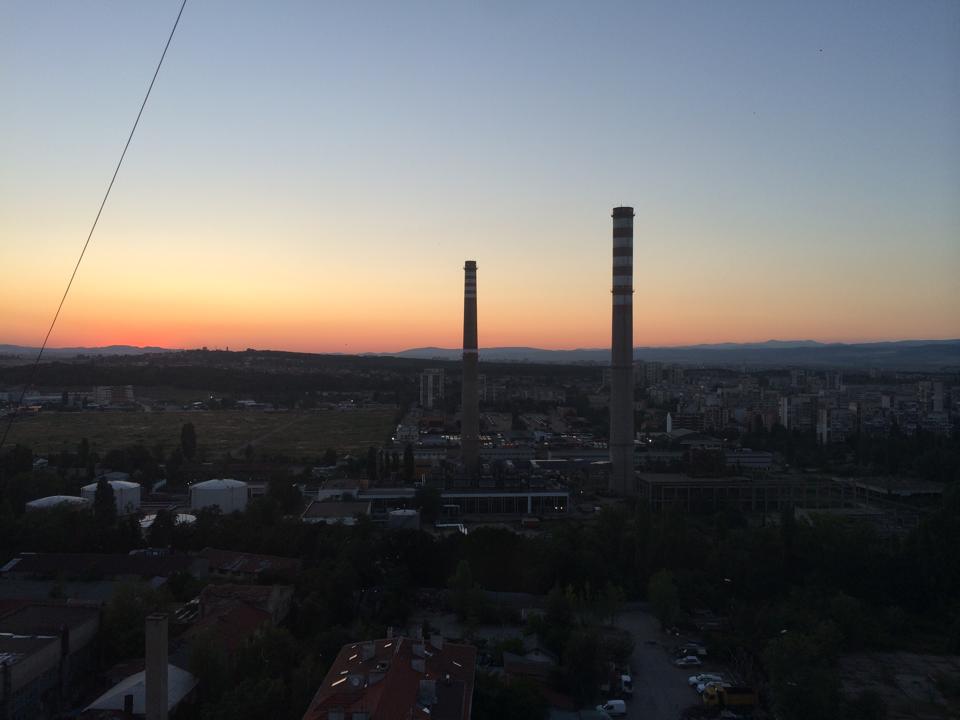
The rest of Sofia is kind of nothing special, because it's mostly huge socialist high rise buildings, which were built during the communist rule over the city. My friend lives on the 17th floor on one of those, which gave me the opportunity to stare at the city at any given time, all the time. I did make use of that, because Sofia has a really beautiful skyline, as it is surrounded by mountains and gives you the feeling of being in a large city, but at the same time, it feels like you're in the middle of the mountains.
The view from my friends apartment: City Centre
The view from my friends apartment: Socialist residential areas
Sofia now is booming because of the EU. Everywhere you can see EU flags and "funded by the EU" signs. The EU helped expand the Sofia Metro, build a new airport, a new railway station and is working on basically everything infrastructure. Basically, since Bulgaria entered the EU, the EU has been paying for everything, which makes Sofia so much more modern, than I expected it. I can't wait to see how this city will develop in the next few years.
EU funded metro line 2
Can't wait to go again,
Stefan.
The Southern Park. Probably the most romantic place for long walks.

Saturday, 18 July 2015

Pride

Dear readers,

Due to the recent events in the USA, regarding the legalisation of gay marriage, I wanted to write a statement on the LGBTQ+ population and its situation around the world. I myself am gay, and wanted to say a few words about this topic, because I feel like there's a few things, that is not being properly said. Personally, I am happy for all US gays and their opportunity to get legally married, in the entire country, in each and every state. I am also happy for all the gays in the world, who live in countries, which have legalised gay marriage (France, the UK, Spain, Slovenia etc.) as well as for all gays in countries where the reigstered partnership is legal (Germany, the Czech Republic, Croatia etc.) and for all the gays in the world, who have an easy life, where they don't have to struggle as much with their sexuality.

I recently dated a guy with the perfect setting for his homosexuality. He grew up in a city, where it is completely normal to be gay, and where no one bats an eye if you hold hands with a person of the same, or the opposite sex. Often he would not understand, just how much I struggle with my sexuality on a daily basis, because even though I grew up in Prague and went to a German School with more than 40 nationalities reprensented, I still originate from Serbia, which is really conservative about the topic of homosexuality. I do not define that struggle as something that gets me discriminated on a daily basis, through verbal abuse or something similar. I more define it as a the struggle to find acceptance in a society, which doesn't grant it to me. And I can understand them, I can completely understand homophobia and the reasons, why people have something against the LGBTQ+ population. It's weird to some social standard, and as long as no one tries to educate societies on their own issues, those socieites are not going to change.

My first travel post on this blog was about Moscow and that was for a reason. I love Russia, and I am fascinated by that country. I wanted to get to know the city, the politics, the people, and understand them, and not judge them. I feel like, if one does not judge, one will not be judged. Most people who hate a specific group, don't even have a reason for it, but are instead tought into it by their parents. In each society there is one unpopular group that is being hated. Whilst in Western Europe, most people accept the LGBTQ+ society, they don't accept Islam, whilst in Islamic countries, they accept other religions, but don't accept the LGBTQ+ society. Whilst in Russia, gays get beaten up at times, in my country (Serbia) and my other country (Croatia) national tensions against each other are building up again. There will always be hate around the world, and for it to stop we must set an example. How can the LGBTQ+ society ever be accepted, if we keep on discriminating those, who discriminate us? We're going in circles over here.

In my life, I have managed to explain to people that alternative sexual orientations are normal and are something that one is born with. Since I move around all kind of societies in the world, especially ones that are not always tolerant, I've learned how to talk to people in a way, that makes them understand that my sexuality, does not offend their beliefs and cultural values. It's difficult to tackle the topic and speak to people about it, and many gay guys I know lose their nerves fairly easily when confronted with homophobia, whilst the key to peace is diplomacy (if used correctly, and if it's not corrupted like most politicians, but that's a story for another time) and understanding. We live in a diverse world, so whilst we promote diversity, we should embrace it, instead of rank it.

Think about it, Stefan

Monday, 6 July 2015

School

Dear readers,

As of June 10th 2015, I am officially no longer a student at the German School of Prague, since I managed to successfully graduate it. I find the feeling of graduation to be rather special, and something, that I can't really find the words for to describe it, because it's a mix of emotions, ranging from extreme happiness to lifetime frustration, as an important chapter of life, comes to an end.

After graduation, I watched most of my classmates chant happily, that they will never have to go to school again, and that is was so horrible going there every weekday at 8am. I admit, it's not a pleasant memory, getting up at 6am every morning, rushing to leave the house, only so you can be the zombie with earphones in, whilst commuting by underground in crowded trains. However, in the end, school is not a bad place to be. Compared to what probably expects me in life, school was nice and enjoyable, and even though I'm glad, that I can move on to university, I will still miss the carelessness of the organization of my day, because I had a regular routine.

As I am writing this, I begin to realize, that many of people I used to see on an everyday basis, will no longer be part of my life. I'm sure that I will stay friends with my current friends as much as I can, but no one of us is staying in Prague, as most of us will move to Germany, as our school hands us a German diploma, and not a Czech one. So, the new life I'm about to start is going to be a life, without my friends around, and if I ever want to see one of them, I have to go see them, or they'll have to go see me. That is a painful thought, considering the fact, that we once used to see each other on a daily basis.

I remember my first day of school fairly well. It was fairly painful. It was at a Czech public school, which I hated the entire year. I cried, I hated it, the kids hated me for being a foreigner (as I'm from Serbia) and some teachers even downgraded my marks, for not speaking proper Czech. The fondest memories I have of that year are my class teacher, who was really kindhearted and always fair, and a girl named Kristýna, who was my "crush" at the time. We always got along really well, and she was kind of the only friend I had.

However, luckily I mastered the German language well enough to be put into the German School of Prague in year 2, saving me from endless terror and putting in a school, where I actually had friends, and was not discriminated for being Serbian. Up until year 5, I was a part of the group and always enjoyed my childhood at the school, for it was the best I could ask for. As I got into years 6 to 9, socializing became more difficult for me and I was the outsider in the group most of the time. This was mostly due to the divorce of my parents and my personal struggels regarding my sexuality.

Years 10 to 12 were my glory years in school. I successfully (at least at my school) came out as gay in year 10, started working on various projects of my own and participated in as many classes as it was possible. I saw my grades improove in those three years and a range of successes. In year 10, I started my Serbian language class, which then got a confirmed trip to Belgrade, we were only 6 on that trip, but it was still a once in a lifetime experience. Except fot the fact that 7 of us did the same thing in year 11 again, gaining more attention from the school and support from our fellow teacher. In year 11, I also discovered MUN and I was part of our schools MUN team for two years, visiting three MUN's whilst at it. In year 12 I started my most ambitious projects, with the introduction of the regional conference for student body presidents of German Schools. A very good friend of mine from the German School of Belgrade helped me launch the project, and so we did. In Belgrade, we met with Warsaw and Zagreb and their representatives, and had the first successful confernce. A week later I was sent to Budapest to present the project to the principals of 12 German Schools abroad in Eastern Europe, by far my biggest success.

Now, I leave this part of my life behind, and look forward to new horizons, new challenges, new topics and new opinions. I have time to travel more now, and more time to write for this blog, and I expect to post more frequently and write more texts about more topics. I'm preparing, so hang on, please. I promise, that it'll be good.

I wish all of you a happy summer! Stefan.

Sunday, 31 May 2015

Warsaw, Poland

In 1944, this city was completely destroyed by the Nazi Regime, almost wiping it off the map. And when the country of Poland got it independence in 1945 under the communist regime, it got the task to rebuild its own capital, which to this day stays one huge construction site.
On May 14th I flew to Warsaw for an extended weekend to visit a good friend of mine, Aleksandra, who had invited me to come see her city. I stayed until May 17th, and the 4 days I spend there, left me absolutely speechless. The city has so much to offer, not just in history, but also in lifestyle. There are more brands, shops and products than in Prague, and the city definitely tries to become as Western as possible. Modern developments include the stadium and the new business centre:
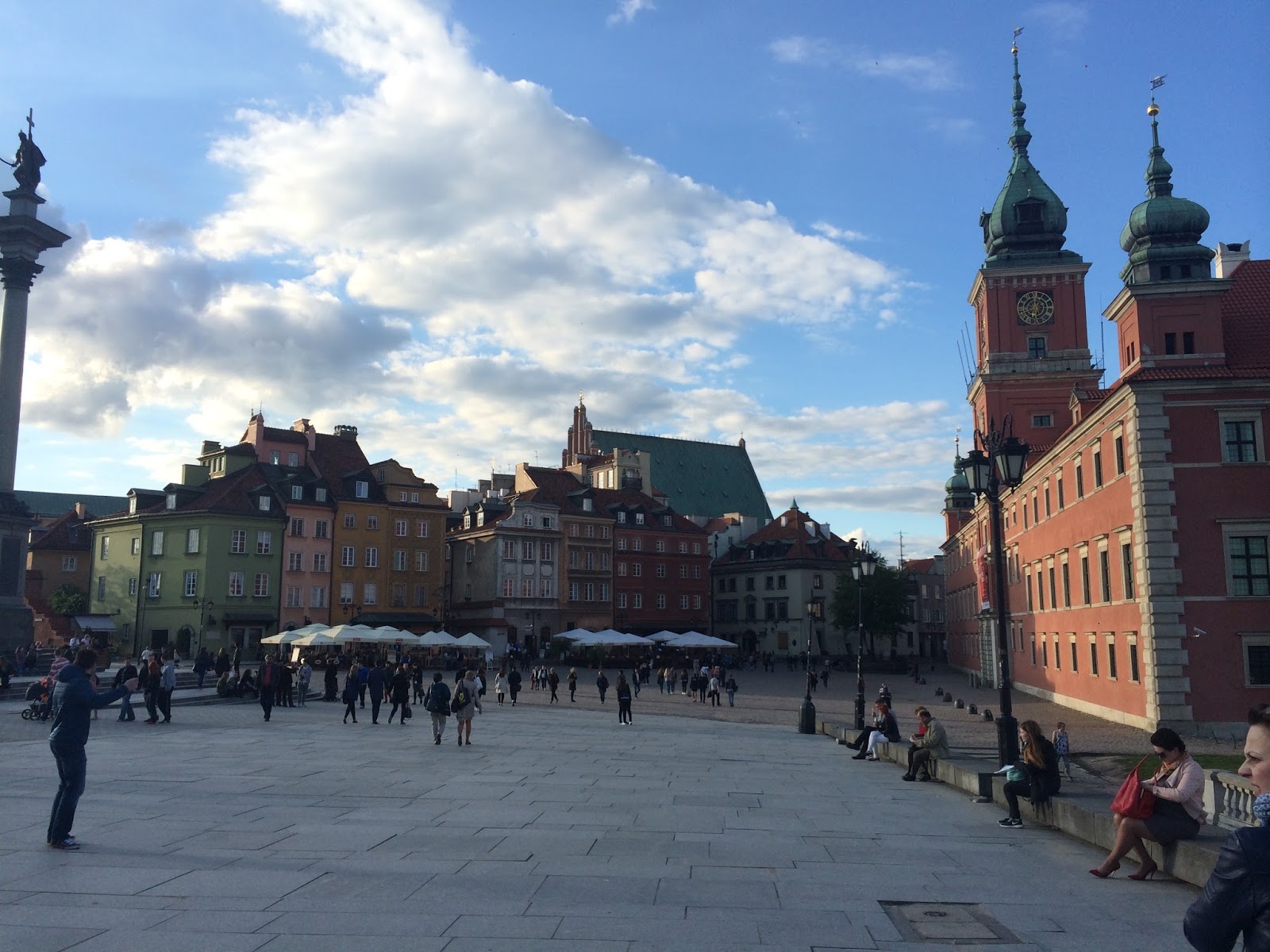
Now, before the Nazis, Warsaw was a small little trading town, with a nice historic city centre and beautiful markets. Most of the old parts have been rebuilt to look as original as possible, with success to be seen:
During the communist era, Warsaw rapidly developed into a representative capital. With its main monument, the Palace of Culture, Warsaw paid tribute to the Soviet Union, by building it in the style of a Stalin skyscraper. Today, it's basically the symbol of the city:
The destruction of Warsaw in 1944 changed the city completely, and it's course in history. On Willy Brandt square, one can find the monument to the fallen, where in 1970 the German chancellor, Willy Brandt well to his knees in order to show respect to Poland, and ask for forgiveness. A few months ago, the museum of Jewish history opened up there. In my opinion, it's one of the nicest museums to go to, as it has an interesting exhibition, which is not centered at the holocaust, but at Jewish history as a whole. I really found it worth a visit.
Monument to the fallen Jews in the Warsaw Ghetto
Museum of Jewish History
Anyways, Warsaw was not only sightseeing for me, but also meeting friends, partying and having a good time in general. Aleksandra and I were walking around most of the time, and she showed me most places. She's just such an amazing person, funny, smart and she knows what she's doing. Something you don't really find often in people! I thank her a lot for this experience I got in Warsaw, and I hope, that one day, I can re-visit her in this lovely city.
Aleksandra and I eating what I consider to be the cheapest ice cream for the fairest price ever.
Waiting for the subway at Plac Wilsona
Aleksandra's wonderful smile :)
On saturday, Aleksandra threw a party, where I got to meet most of her friends. They were all very nice people in my opinion, and they sure know how to have fun. It was one of those rare house parties, where everyone's drunk to the point, that they're having fun, without annoying anyone else. Nothing broke, no body felt sick, and everyone seemed to enjoy the party.
I couldn't find many party photos on my phone, but I did find this one, which I cherish. Elena (left) and Ewa (right) are two of Aleksandra's best friends and in my opinion amazing people. 
When I left Warsaw, I was struck with this wish to go again, but not for the tourism, but for the life. Warsaw is not a city, with offers full time entertainment for tourist in the form of sightseeing, but more in the form of living. If you know the right people in Warsaw, you are bound to have a good time.

From Poland with Love, Stefan.

Friday, 29 May 2015

Eurovision 2015

Dear readers,

If there is one reason for me, to turn on the TV, it's the Eurovision Song Contest. Since the 2015 edition is now over, with Semi Finals taking place on May 19th and May 21st and the Grand Final taking place on May 23rd, I would like to make my personal comments on the entries this year.

For all of those, who don't know what Eurovision is: It's a music competition between countries, which fight for first place, in order to host the contest next year. In the two semi finals, 10 from each are being passed to the final, along with the Big5 (Germany, United Kingdom, France, Spain and Italy) as well as with the winner of the previous year (Austria won in 2014) and special guests (Australia in 2015), which get to the final immediately. You can find an explanation on the voting procedure here.

Semi Final 1

In the First Semi Final, 16 countries competed for the final, with the results ending up like this:
1. Russia (182pts)
2. Belgium (149pts) 
3. Estonia (105pts) 
4. Georgia (98pts) 
5. Romania (89pts) 
6. Greece (81pts) 
7. Armenia (77pts) 
8. Hungary (67pts) 
9. Serbia (63pts) 
10. Albania (62pts) 
11. Moldova (41pts) 
12. Belarus (39pts) 
13. Denmark (33pts) 
14. Netherlands (33pts) 
15. Macedonia (28pts) 
16. Finland (13pts)

This first Semi Final was opened with the performance of Moldova, which was the first country in the running order, and which also presented a rather interesting performance. The singer portrayed as a criminal, and the dancers dressed as the police, with the female dancers, wearing less uniform and showing more skin. I'm not surprised the song failed.

Belarus had a very good song, to which I've listened a few times prior to the contest, and I did enjoy it, yet the live performance was not impressing at all. His voice sounded weak, and one could see, that the reason the song previously sounded so good was auto-tuning.

Finland came in last, with a punk group, whose members all have autism. The song was the shortest ever at a Eurovision Song Contest, with only 100 seconds of duration. In general, I found it nice, that virtually everyone can participate in Eurovision. However, I'm not surprised, that Finland came in last, as the song was just a mediocre punk/rock song, sang for only 100 seconds, and always in the same tune. It was nothing the public would like.

Without a doubt, Russia had the best performance of the evening, with a lot of energy and a really good song. I really enjoyed the song and it's message. However, that's where the contest got political, as during Russia's performance, everyone held up their LGBT flags, waving them around the arena. This is where the contest really gets annoying, as it is used for political interest, and has been used for it in the past 60 years.

I was moved by Estonia, as the song really had emotion in it, and the lyrics themselves are nice and simple. I find it a job well done.

Without a doubt, Serbia had the crowd on their side, with the crowd cheering like hell, during their performance! It was an honor seeing my country perform so well, and end up in 10th place in the Grand Final, thus making the TOP10 of this years contest. I was really proud of Serbia this year.

Semi Final 2

In the Second Semi Final, 17 countries competed for the final, with the results ending up like this:
1. Sweden (217pts)
2. Latvia (155pts)
3. Israel (151pts)
4. Norway (123pts)
5. Slovenia (92pts)
6. Cyprus (87pts)
7. Lithuania (67pts)
8. Poland (57pts)
9. Montenegro (57pts)
10. Azerbaijan (53pts)
11. Malta (43pts)
12. Ireland (35pts)
13. Czech Republic (33pts)
14. Portugal (19pts)
15. Iceland (14pts)
16. San Marino (11pts)
17. Switzerland (4pts)

After seeing the results, I felt bad for Switzerland, as I quite enjoyed their song, and hoped for them to get a spot in the final. Seeing them end up in last place with only 4 points is kind of a bummer, considering, that they submitted a better song, than in the past few years.

The song that got me in this Semi Final was Latvia. That voice is so powerful, and I really enjoyed the performance. I was really happy seeing them pass into the final. Every time she would sing "your love" loudly, I'm flashed by her voice, and it's just such an addicting sound. The song is well written, I must admit that.

Poland came with an interesting performer as well, and I do admire her, still singing, even though she's in a wheelchair. Her song was nice, and she did fully deserve going to the finals.

The Czech Republic returned to the contest, again failing to qualify, but at least scoring points, making 13th in a Semi Final their best result so far. It was nice being able to vote again, as living in the Czech Republic restricted me from voting previously. The song was a nice ballad.

Montenegro had a nice tune. The only song sang in Serbian this year, and again another ballad to enjoy. Though I am not a huge fan of Knez, I still liked seeing familiar faces in Eurovision. At least something to recognize.

Slovenia was rather interesting, with the dancer performing on an air violin. The singer had a weird voice, and the tune was kind of not catchy enough. And somehow, for some reason, I still liked it. Maybe it was the combination...

Grand Final

Now, 27 countries participated in the Grand Final of the Eurovision Song Contest, and this is how Europe (and Australia) have voted on them!
1. Sweden (365pts)
2. Russia (303pts)
3. Italy (292pts)
4. Belgium (217pts)
5. Australia (196pts)
6. Latvia (186pts)
7. Estonia (106pts)
8. Norway (102pts)
9. Israel (97pts)
10. Serbia (53pts)
11. Georgia (51pts)
12. Azerbaijan (49pts)
13. Montenegro (44pts)
14. Slovenia (39pts)
15. Romania (35pts)
16. Armenia (34pts)
17. Albania (34pts)
18. Lithuania (30pts)
19. Greece (23pts)
20. Hungary (19pts)
21. Spain (15pts)
22. Cyprus (11pts)
23. Poland (10pts)
24. United Kingdom (5pts)
25. France (4pts)
26. Austria (0pts)
26. Germany (0pts)

Without a doubt, Sweden is a worthy winner to this contest. Great song, great melody and a great text. A simple message to pass on, and a catchy tune. Watching Måns work his way up to the top spot was enjoyable, even though I would've been fine with Russia winning, I liked them.

I already noticed Georgia in the First Semi Final, with their song "Warrior" and I admired Nina for that strength she shows. In the final, she again killed it with her performance, and the song just has something, which I find oddly charming. I hoped, for her to get into the TOP10.

A very warm welcome was given to Australia and Guy Sebastian who finished in 5th place, with his catchy song "Tonight Again". I did enjoy that a lot. Australia in Eurovision is really refreshing, as they don't come up with the same style of song, which is delivered by the european countries, each and every time. So I'm really glad, that Australia placed itself in the TOP10.

There's something oddly charming about Loïc's song from Belgium. Is it its originality, maybe? Almost making the TOP3, Belgium ended up in 4th place, which they deserved, as the song was just so different, that it made it good. Also, it was nice seeing a Benelux country doing well in Eurovision again.

After 12 years, there have been Nul Points in the Grand Final again, given to Austria and Germany, and whilst I'm not really sorry for Austria, I do pity Germany. Their song was not bad. In fact it was better than what Germany delivered in the past few years! Ann Sophie did a good job, and should've at least gotten some points.

Italy was the only country of the Big5, which was not amongst the last 7 countries, but made it into the TOP3 countries, with "Grande Amore". Their singing was true talent, along with the fact that Italy was definitely the best dressed country at Eurovision this year.

Israel had a very funky tune, so I'm glad that they made it into the TOP10. I can't get how that singer is 16. It just seems so unbelievable to me. Also, the song sounded so much, like it was from an Arab country, that it did kind of freak me out, that the country singing it was Israel. Nonetheless a great tune.

Last but not least, Norway killed it, with the darkest song of the evening. The story of a young boy killing someone and later admitting it to his love, was definitely an original story to sing. The way it was presented really left me speechless.


In general, I'm really satisfied with this years Eurovision, as the entries submitted were relatively good on average, and the winner is someone I can agree with. The show was great, Austria is a great host country, and Vienna a wonderful city to host the contest. The hosts were great, and Conchita got her portion of attention, by hosting the green room. 

I'm looking forward to Eurovision 2016 in Sweden!

Wednesday, 29 April 2015

I will not be silenced #freedomofspeech

Dear readers,

today, I would like to talk about a right, that is very important to me, and that is, the right entitling us to the freedom of speech. I am privileged. I am privileged to live in a country on the globe, where I can freely express my thoughts and opinions, without having to fear a governmental threat. Living in the Czech Republic really helped me get the opportunity to express myself. Since I was a little child, I loved that. I was always direct, and always said what's on my mind. As a teenager, I loved making videos and post them on YouTube (even though my opinions didn't really get much of a positive feedback) and a few years ago, I found my true and only love, writing.

About 5% of the words I've written, get the chance to be read by someone else, and only a part of those 5% actually gets on this blog, or gets into a book, which I'll eventually publish. I try to do my best to get a message across to the people reading this, because I also hope, that it is not only I who writes, but also you who reads.

However, there are a lot of problems caused by freedom of speech, which to some extent limit the freedom itself. I once made a video called "Things I don't like about CZECHS", in which I stated some points which I didn't really like about the Czech Republic, and kept it there. It had about 200 views when I checked on it last time about a year ago, on monday it had over 6.000, after a former crush of mine pointed that out to me. I'm saying former, because as a Czech person, one does not really tolerate the Serbian criticizing ones homeland. So that ended badly. I took the video down. I personally thought, that I had the right to freedom of speech, so I decided to simply say, what I think, but I was not ready for all the rude comments, telling me to die. Now, where do we find freedom of speech in that? I do respect criticism, but I disregard offenses.

This got me thinking: Are offenses still freedom of speech? Because, I never meant to offend the Czech Republic in my video, I just question some behavior of the society here, and yet the replies are direct offenses towards me. Are we abusing our freedom to speak up? Since I was recently in Russia, I saw how many people were scared to even say something, about anything, thus being scared to express themselves. And once they do get the chance to say something, they take good care of their words. We, who are used to the freedom of speech, abuse it so much, that we forgot about the true value of this right.

I won't make this post all to long, but I'm working on texts tackling difficult topics, and I hope, that each reader will keep these thoughts on the freedom of speech in mind, as I do value respect and tolerance. I want to make it clear, that I have my opinions, and that I do want to get some of them across to other people, as I feel, that some topics should be tackled, and that's what this blog is also kind of for, so I'm hoping, that it'll go well.

If you have any thoughts on the freedom of speech, please write me a comment, I would really appreciate it! Thank you so much!

Best regards, Stefan!

Sunday, 5 April 2015

Moscow, Russia

First of all, I would like to apologize for not posting in a while, but I have been very busy with my travels, and I'd like to share a journey with you. From March 28th until March 31st 2015, I enjoyed my holidays in Moscow. I landed at 4:20 in Moscow, with no luggage, since my first flight from Prague to Belgrade was delayed, and barely made my connection onwards to Moscow. Also I forgot my laptop charger, so the journey was bound for adventure. Russia became the 28th country I've seen in my life so far.
St. Basil's Cathedral during sunrise.
The Red Square by night.
Moscow in general is a really beautiful city, no matter if you're strolling through the red square next to the Kremlin, or if you're in one of the many shopping streets in Moscow, or even if you're visiting a socialistic monument. Moscow has a lot to offer. I personally enjoyed being on the Red Square, as it's surrounded by beautiful buildings and structures, like St. Basil's Cathedral, the Kremlin and even Lenin's mausoleum. It's the heart of Moscow, and the only place where you can also find other tourists. Since I speak Russian, I was surprised to find out, that many of the tourists on the Red Square are Russians or from a country of the former Soviet Union, visiting their capital. A nice woman from Kaliningrad even did a photoshooting for me at the Red Square.
Me on the Red Square, with the Kremlin in the background.
The GUM Shopping Mall on the Red Square by night.
Of course, Moscow does not only consist of the red square, it also features many other beautiful places from its history. Moscow began its development as an important city under the rule of the Russian Royal Family, which was in power of Russia until 1917. However, at that time, Moscow was not the capital of Russia, and thus all important palaces and structures of the Royal Family themselves stands in todays St. Petersburg (formely called Petrograd [until 1917], and Leningrad [1917-1990]). Moscow kept some beautiful buildings though, like the Arbat street and the Bolshoi Theatre. Another beautiful street would be Kuznetsky Most, also preserved from that time.
The old Arbat street.
The Bolshoi Theatre
Kuznetsky Most
In 1917, Moscow became the capital of the Soviet Union (the USSR, in Russian: CCCP [standing for SSSR]), the first socialistic state of its era. After World War II and up until 1990, the Soviet Union was the leader of the Eastern Block (the states of the Warsaw pact) and was dramatically oversized. Whilst the old part of Moscow is rather modestly small, the parts built by the communists are huge. Since in 1917, Moscow had to be shaped into a representative capital, it was expanded into all directions, making it the Mega Metropolis it is today. Moscow also features a unique street system, going in circles all the time, to keep traffic from the city's core. The following four shots have been made from the Ostakino Television Tower, built in 1967, which is the tallest structure in Europe.


As you can observe on the pictures, most of Moscow's residential parts are shaped by the socialist architecture, which forsees block buildings and housing for many people on as little space possible. However, even though the housing was minimalized to a small space, the public places built in the communist era are some of the largest I've seen. The communists really had an idea on how to present themselves as strong and important. Most of the squares honoring heroes from World War II, or heores of the revolution in 1917, or even the cosmonauts (astronauts) of the Soviet Union, got very large monuments, accompanied by a huge surrounding area.
Exhibition Centre
Park Pobedy (The park of the winners)
Park Pobedy in the distance
Monument of the Cosmonauts
Moscow can be divided into three eras: The Era of the Royal Family, The Era of the Soviet Union and The Era of Russia. The current era thus exists since 1990, and showcases the development of the capistalistic economic system and its impacts on the new democratic Russia. In the past few years, before the sanctions came into place in 2014, Russia had a growing economy due to its natural resources and profited from it. Moscow can see this economic rise in its urban development, as the brand new Moskva-Siti project is being developed. Moskva-Siti host high rise office buildings, hotels and residential areas, as well as a mega mall, and is the new hub for the Russian economy, showcasing, that Russia is moving on, and keeping up with the current global pace.

We in the West like to think of Russia as the corrupt country, which limits human rights, especially regarding the LGBT community, and as the mad country, which invades the territory of other countries, most recently regarding the Crimea issue. We also like to think of Russia, as a country of censorship, and unfortunately, to some extent, that is true. Russian newspapers seemed very censored to me, and didn't give basic information in some cases, when it came to international politics, and I tried to find some articles which were critising the government, and I did find some, after a long search and a lot of struggle. I talked to a former journalist, and she told me, that there were things, she was not allowed to write, even though the entire population was aware of the situation, it was not supposed to be explicitly mentioned. She refused to tell me the actual issue, but confirmed my theories on censorship in Russia. Another interessting fact about Russia: Many museums prohibit photography entirely, and some charge you extra if you want to take pictures, but you may not post them on the internet, as it is illegal. I refused to pay the extra charge, thus I didn't take pictures in museums, because I didn't want to pay anything in museums, as in Russia, almost all cultural activities for minors under 18 years of age, are free of charge, which was a pleasent surprised for a solo 17 year old traveller on a budget like me.
The Temple of Chirst the Saviour
Now, let's talk about the Russians for a while. The Russian people are some of the nicest bunch I've met in my entire life. They have a sense of hospitality, and when they see a foreign tourist trying to speak Russian, they immediately appreciate the effort. I suppose, that this comes from the Russian-Orthodox church, as most Russians are religious, they have a stronger sense of community and unity. The church is powerful in Russia, and it brings people together, which is nice. I myself am Serbian-Orthodox, and thus direct affiliated with the Russian-Orthodox church, so I know a thing or two about it. Even though the church forces some outdated values on the population, it also brings the communty together and makes them work as a whole, and the combination of living in a time after communism in a religious country, makes it much more safer to walk around Moscow, than New York. Everyone in Moscow minds their own business, but is also happy to help if you need it, thus they are open towards others, but don't want to harm them. I felt safe in Moscow, pickpocketing in being held to a minimum and the crime rate is astonishingly low. I even had my hotel next to the central mosque in Moscow, close to Prospekt Mira, and I didn't feel unsafe, I enjoyed the clash of cultures, as many muslims from the other ex-soviet republics were there, and I was lucky to observe such a feeling of community.
A station on the Moscow metro, the most beautiful metro system in the world, with almost all stations decorated like this.
Name: Komsomol'skaya
Now, when one observes the prejudices, we all have against Russians, most of them are true, but on a different level. It's not true, that they drink vodka in masses, because they are a nation of alcoholics, but because the feeling vodka gives you is like a warm wave in your body, which can really be good for you, when you live in freezing Moscow. I dealt with temperatures of down to -4 degrees celcius and up to 6 degrees celcius, whilst visiting Moscow during the end of March. I do not wish to experience the weather in winter.
A park in Moscow on March 31st 2015
Russians are also very famous for being intolerant, also complete nonsense. Sure they have laws against the LGBT population, and many people discriminate them, but we can't call the Russians intolerant, if the call the western world tolerant, whilst they discriminate against muslims and also Russians. Many of my friends from Prague didn't want me to go to Moscow, because they hated Russia, and also didn't trust the people there, whilst the people welcome every visitor, who's nice to them, and respect every religion and nation. And this is not me trying to spread propaganda about the Russians, this is my serious opinion about them. I think, that everyone should go see Russia for themselves and then judge them, but we judge by the media so much, that we won't even let our friends go to Russia, because we're scared of the unknown. Intolerance is nothing but a fear of the unknown. And it discrimination happens in Russia, as much as it happens in the EU and the US. Ferguson is always a perfect example.
A typical Stalin skyscraper
My final point on Russia would be, that their political situation can be compared to the USA. I'm going to raise a very unpopular point here, but Russia seems to be oddly similar to the USA. In both nations, patriotism is widely spread, both nations have very religious communities, and both nations are superpowers. Also, and I know most people will not like this statement, both nations invade other countries. We all blame Russia for taking Crimea, but when we look at the USA in past few years, they invaded Iraq, Afghanistan, Vietnam, Serbia, Lybia etc. etc. Personally, I believe the reason why the USA and Russia hate each other so much, is because they are so alike. Think about it.

Tretjakovskaya Art Gallery
To sum it all up, my experience in Russia was extremely pleasent, and I enjoyed strolling through the streets of Moscow and seeing most of the cultural sights, very much and I hope to return soon to Russia, hopefully to Moscow as well, but it would be nice to see other cities as well.

From Russia with Love, Stefan.